A warehouse lighting upgrade is not a simple fixture swap. Poor light levels slow picking, hide rack labels, increase forklift risk, and make quality checks harder than they should be. Knowing how to modernize warehouse lighting starts with treating illumination as part of the facility’s operating system – one that affects safety, labor efficiency, power use, maintenance, and inspections.
For property owners, industrial operators, and general contractors, the right upgrade delivers better visibility where people work while reducing the electrical load and maintenance burden. The wrong one can leave dark rack faces, glare at workstations, nuisance control behavior, or electrical infrastructure that cannot support the new system reliably. A well-planned warehouse lighting installation helps prevent those issues.
Start With a Lighting Audit, Not a Fixture Catalog
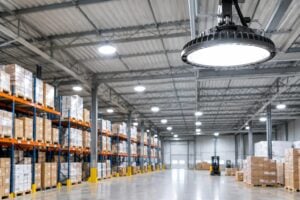
Every warehouse has different ceiling heights, rack layouts, shift schedules, and operating hazards. A distribution center with narrow aisles and 36-foot ceilings needs a different lighting plan than a low-bay parts warehouse with frequent packing activity. The first step is documenting existing conditions before selecting LEDs or controls.
A qualified lighting audit reviews fixture types, mounting heights, wattage, circuiting, panel capacity, emergency lighting, and actual light levels across the space. It should also identify areas where lighting quality matters more than average brightness: receiving docks, loading doors, stairwells, battery charging areas, quality-control stations, mechanical rooms, and pedestrian crossings.
Foot-candle readings provide a useful baseline, but they are not the whole story. Light on the floor may look acceptable while rack labels, pick faces, and vertical work surfaces remain difficult to see. Shadowing from racks, conveyors, mezzanines, or stored inventory should be evaluated during normal operations, not in an empty building.
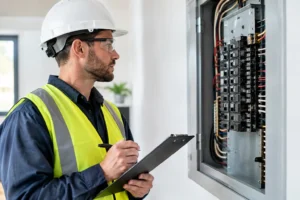
The audit is also the right time to identify aging wiring, overloaded circuits, damaged branch wiring, or panels with limited capacity. A lighting project often exposes electrical issues that were easy to ignore under an older system. Addressing them during the upgrade is usually more efficient than reopening the work later.
Set Lighting Levels Around the Work Being Done
The goal is not to make every square foot equally bright. It is to put the right amount of useful light in the places where employees, equipment, and inventory need it. Excessive light wastes energy and can introduce glare. Insufficient light creates avoidable safety and productivity problems.
General storage aisles may require a different lighting approach than active picking zones. Packing and inspection stations often need higher-quality, more consistent illumination because employees are reading labels, confirming product condition, or handling small components. Loading docks need dependable light transitions so drivers and workers are not moving between overly bright interiors and dark exterior conditions.
Color temperature should be selected deliberately. Many industrial facilities use neutral-to-cool white light because it supports visual clarity and alertness. However, the best choice depends on the task, surfaces, and the preferences of the people working in the building. Color rendering also matters when workers must distinguish wire colors, product markings, labels, or damage.
A photometric layout is the practical way to confirm these decisions before installation. It models fixture placement, beam distribution, mounting height, and expected illumination across the actual floor plan. For racked storage, it should account for aisle orientation and light reaching the vertical faces of inventory.
Choose LED Fixtures for the Building, Not Just the Wattage
LED high-bay fixtures are a standard choice for many warehouses because they offer long service life, instant startup, and major energy reductions compared with metal halide or fluorescent systems. Still, not all high bays perform the same way. Fixture distribution, driver quality, thermal performance, impact resistance, and serviceability all affect long-term results. Our lighting upgrades work starts from these building-specific factors.
High ceilings and open storage areas may benefit from fixtures with a wider distribution pattern. Narrow aisles can require a more focused optic that pushes usable light down the aisle instead of spilling it onto the tops of racks. In areas with heavy dust, moisture, vibration, or washdown exposure, the fixture’s environmental rating must match the condition on the floor.
Do not select fixtures based only on advertised lumens. A high-lumen fixture with poor optics can create bright spots and dark gaps. Likewise, a lower-wattage fixture may deliver better task visibility when its distribution is properly matched to the space.
Maintenance access is another real-world consideration. Long-life LEDs reduce relamping, but drivers and other components can still fail. In a facility with tall ceilings, every service call may involve lifts, aisle closures, and coordination with operations. Specify equipment that is suited for the environment and supported by a dependable warranty and replacement process.
Add Controls Where They Produce Real Savings
Controls can significantly improve the return on a warehouse lighting upgrade, but they need to match how the building operates. Occupancy sensors work well in intermittently used aisles, storage zones, restrooms, offices, and utility rooms. Daylight harvesting can reduce output near skylights or dock doors when natural light is consistent and useful.
The key is commissioning. Sensors need the correct coverage, time delay, dimming level, and grouping. If an aisle goes too dim while a picker is still working, employees will bypass the system. If the timeout is too long, energy savings will be limited. A practical design often uses a lower standby level rather than shutting off lighting completely in active warehouse areas.
Networked controls can provide scheduling, zone control, energy monitoring, and easier changes as layouts evolve. They are especially useful in larger facilities with multiple operating schedules. For a smaller warehouse with stable hours, simple occupancy and photocell controls may provide most of the benefit at a lower upfront cost.
Emergency and egress lighting must remain reliable regardless of the control strategy. Lighting controls should never compromise required exit paths, emergency operations, or safe shutdown procedures.
Plan the Electrical Work and Code Requirements Early
Modern lighting is more efficient, but a retrofit can still require careful electrical planning. New fixture locations may need branch-circuit changes, added controls wiring, low-voltage cabling, new junction boxes, or panel modifications. Existing circuits should be traced and verified instead of assumed.
Code compliance is a core part of the project, not a final inspection item. Requirements can affect lighting power density, automatic shutoff, daylight-responsive controls, emergency lighting, labeling, mounting methods, and permit documentation. California projects may also have energy-code requirements that shape fixture and control selections. Arizona and Nevada requirements vary by jurisdiction, so the design should be reviewed for the specific site.
For occupied facilities, installation sequencing matters just as much as the design. Work should be coordinated around shipping windows, forklift routes, rack access, and safety zones. A phased installation can keep operations moving, but it requires temporary lighting and clear communication so teams are never working in an unsafe or poorly lit area. Related tenant improvement work often follows the same coordination approach.
Measure Results After Installation
A lighting upgrade is not finished when the fixtures turn on. Final testing should confirm the controls operate as intended, emergency systems function properly, circuits are labeled, and illumination is consistent throughout the facility. Walk the space with warehouse leadership and employees who use the area every day. Their feedback often identifies glare, shadows, or control settings that a drawing cannot predict.
Track energy consumption and maintenance activity after the project. These figures help validate savings, support future capital planning, and identify opportunities to improve other electrical systems. If the facility changes its rack layout, hours, or work processes, revisit the lighting zones rather than accepting poor visibility as the cost of change.
A well-executed warehouse lighting modernization protects people, supports faster work, and reduces operating costs without creating new electrical or maintenance problems.
Why Left Coast Electric
Left Coast Electric is a commercial and residential electrical and low-voltage contractor based in San Dimas, CA (CA Lic #1105569). We serve Southern California, including Orange County, the San Gabriel Valley, the Inland Empire, and LA County, as well as Arizona and Nevada. Commercial projects we have worked on include North Italia (Brea), Quick Quack Car Wash, The Claremont Club, the LA County Arboretum, and Ortho AZ. From our San Dimas home base, we offer free estimates and 24/7 emergency service.
Can warehouse lighting be upgraded without shutting down operations?
Usually, yes. Work can be phased by zone or scheduled during off-hours so aisles, docks and racking areas stay usable while each section is upgraded.
What should be checked before a warehouse lighting retrofit?
Ceiling height, racking layout, existing circuits and panel capacity, controls, and any local energy-code requirements. A site walk lets the contractor confirm what the existing system can support.
Are lighting controls worth adding during an upgrade?
Often. Occupancy sensors, daylight sensors and zoned controls can cut energy use in areas that aren’t always occupied, and installing them during the retrofit avoids a second round of work.
Does Left Coast Electric handle warehouse lighting projects outside California?
Yes. Left Coast Electric works on commercial and industrial projects in California, Arizona and Nevada. Call 877-960-1122 to talk through your facility.
Ready to modernize warehouse lighting? Request your free estimate or call us at (877) 960-1122.