A commercial solar project is no longer just a row of panels on a roof. The commercial solar energy trends shaping California, Arizona, and Nevada now affect service sizing, switchgear capacity, battery placement, utility interconnection, fire access, and how a building uses power after sunset. For property owners, developers, and project teams, the best results come from treating solar as part of the electrical system from day one, not as an add-on after construction is complete.
The market is moving toward systems that do more than produce electricity at midday. Commercial owners want lower operating costs, more control over demand, backup capability during outages, and equipment that can support electric vehicles and future load growth. That changes the conversation from panel count to electrical design.
Solar Energy Trends That Matter on the Jobsite
Several changes are driving commercial solar decisions across the West. Some create clear opportunities. Others require more planning, better documentation, and realistic expectations about payback. The common factor is that solar performance increasingly depends on the rest of the electrical infrastructure.
Battery storage is becoming a core project decision
Solar production and a facility’s highest demand do not always occur at the same time. A warehouse may see its peak load late in the afternoon. A retail center or restaurant may peak in the evening, after solar output has dropped. Solar alone reduces the energy purchased while the system is producing, but it does not automatically provide power during an outage or eliminate every demand-related charge.
Battery storage can store excess generation for later use, support selected critical loads, and help reduce utility demand exposure in the right commercial application. It is not automatically the right investment for every building. Storage adds equipment cost, requires dedicated space and clearances, and may trigger upgrades to service equipment, distribution, or controls.
For critical facilities, the key question is not simply, “How many batteries?” It is, “What must stay operational, for how long, and under what conditions?” A well-designed system identifies essential loads such as refrigeration, communications, security, life-safety support equipment, selected lighting, or process controls. It then coordinates solar, batteries, generators where applicable, and transfer equipment into a tested emergency-power strategy.
Electrical switchgear is becoming a limiting factor
Many commercial and industrial properties have adequate roof area for solar but lack practical space in their existing electrical equipment. Facilities may have full switchboards, aging gear, insufficient bus capacity, or no clean path for a solar backfeed breaker.
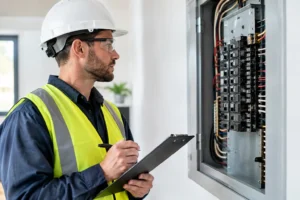
This is why an early site assessment matters. A qualified electrical contractor should review the main service rating, switchboard and panel condition, available breaker space, conductor sizes, grounding and bonding, equipment listings, and the location of the proposed point of interconnection. The review should also account for planned loads, not only current usage.
A property adding solar today may add EV charging, electric HVAC, commercial kitchen equipment, or expanded tenant loads tomorrow. Designing only for present conditions can turn a straightforward installation into a second upgrade project a few years later. In many cases, a service modernization is the practical foundation for solar, not an optional extra.
Smart controls are making solar more useful
Production matters, but control matters too. Modern energy management equipment can monitor solar generation, battery state of charge, building load, and utility consumption in near real time. It can prioritize critical circuits during an outage, shift discretionary loads, and prevent a battery from being drained by equipment that does not need to run.
For commercial operators, that can mean scheduling EV charging, managing HVAC operation, or coordinating battery dispatch around a facility’s load profile, including across multiple sites.
Controls must match the building’s actual operating needs. An overly complicated system can create confusion for maintenance staff. A simple, well-labeled system with a clear operating sequence is usually more valuable than features no one will use.
Rooftops Are Not the Only Commercial Solar Opportunity
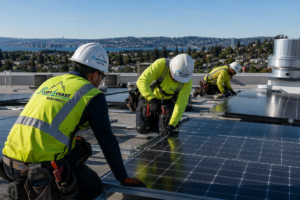
Commercial rooftop solar remains common, but site conditions determine whether it is the best fit. Roof age, structural capacity, shading, drainage, access paths, parapets, rooftop equipment, and future maintenance all affect the final design. Installing solar over a roof near the end of its service life can create unnecessary removal and reinstallation costs later.
Carports are gaining attention, particularly at offices, retail sites, and facilities with large parking areas. They can produce energy while providing shade and creating a natural location for EV charging. The trade-off is more extensive structural work, trenching, lighting coordination, and potential civil-site impacts. They are not a shortcut, but they can be a strong long-term asset when planned with the broader site electrical system.
Ground-mounted arrays can also make sense where land is available and zoning allows it. They require careful attention to setbacks, grading, utility routing, security, and equipment access. For industrial or agricultural properties, the ability to position an array for production and serviceability may outweigh the additional site work.
The Grid Connection Still Sets the Rules
Solar equipment may be on private property, but it connects to a utility system with its own interconnection standards and approval process. Utility requirements, local codes, permitting timelines, and incentive structures vary by jurisdiction and can change. Project teams should avoid making financial assumptions before confirming current requirements for the specific site.
Interconnection is more than paperwork. It affects inverter configuration, protective devices, metering, labeling, disconnect placement, and the allowable size of a system. A project may need a utility study, service modifications, or additional protective equipment before permission to operate is granted.
For developers and general contractors, the practical takeaway is to bring electrical and solar coordination into pre-construction. Reserve equipment space, confirm utility service capacity, coordinate roof and structural details, identify conduit routes early, and establish responsibility for interconnection documents. Late changes can affect schedules, tenant turnover, inspections, and budgets. Teams planning this work can learn more about our commercial solar design and installation services.
Designing for Electrification, Not Just Solar
Solar is increasingly part of a wider electrification plan. A commercial building that produces power on site may also be moving from gas equipment to electric, adding fleet or customer charging, upgrading HVAC, or improving resiliency. Those decisions are interconnected because they all compete for electrical capacity.
Load calculations should reflect realistic use, diversity, and future expansion. A large solar system does not necessarily eliminate the need for a service upgrade, especially when new electric loads are being added. Conversely, intelligent load management may allow some properties to defer costly infrastructure work. The answer depends on usage patterns, equipment ratings, utility rules, and the owner’s operational priorities.
This is where disciplined design pays off. The goal is not to oversize every component. It is to build an electrical system that is code-compliant, serviceable, and ready for the loads the property is likely to carry. For facilities where uptime matters, solar and storage should be coordinated with critical electrical systems planning.
What Owners Should Ask Before Approving a Solar Scope
Before finalizing a project, owners should require clear answers about the condition and capacity of existing electrical equipment, the roof or site constraints, expected production, battery capabilities, utility approval requirements, and what happens during an outage. They should also confirm who is responsible for permits, inspections, commissioning, monitoring setup, and warranty coordination.
The lowest initial proposal is not always the lowest project cost. A scope that skips switchgear work, roof coordination, code-required upgrades, or interconnection details can produce change orders later. On the other hand, not every property needs batteries, a service replacement, or the largest possible array. Good planning separates required work from optional improvements and explains the operational benefit of each.
The strongest solar investment is the one that fits the property it serves. Start with the loads, the equipment, and the operating plan, then build the solar system around them.
Why Left Coast Electric
Left Coast Electric is a commercial and residential electrical and low-voltage contractor based in San Dimas, CA. We offer commercial solar design and installation in California, Arizona, and Nevada (see our Arizona service area), and we serve Southern California including Orange County, the San Gabriel Valley, the Inland Empire, and LA County. We approach solar as an electrical project first: safe installation, proper integration, clean workmanship, and equipment that is ready for inspection and long-term service.
Commercial projects we have worked on include North Italia (Brea), Quick Quack Car Wash, The Claremont Club, the LA County Arboretum, and Ortho AZ. We are licensed in California (CA Lic #1105569) and offer free estimates and 24/7 emergency service.
What types of solar projects does Left Coast Electric work on?
Commercial and industrial projects, including rooftop and ground-mounted systems for business, warehouse and industrial facilities.
What affects the scope of a commercial solar project?
Available roof or ground space, the building’s electrical service and panel capacity, utility interconnection requirements, and local permitting all shape the design.
Can solar be paired with battery storage or EV charging?
Yes. Many commercial sites plan solar alongside battery storage or EV chargers, and the electrical design should account for all of them together.
Where does Left Coast Electric work on commercial solar?
Across California, Arizona and Nevada. Call 877-960-1122 to discuss your project.
Planning a commercial solar project? Request a free estimate or call (877) 960-1122.